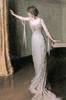
después de lo bien que me trató Sutherliano en Oviedo, no puedo "hacer como que no he visto" este artículo que me han hecho llegar
Ladies and Gentlemen, Dame Joan!!!!!!!!!! ( o Juanita, para los que somos de naturaleza ireverente...

)
Joan Sutherland was the most acclaimed Lucia and Norma of her era, but she also spent a lot of time delving into oddball territory, usually at the prompting of her husband and trusty career guide, Richard Bonynge. IRA SIFF has a word with the celebrated duo in stereo.

The names Joan Sutherland and Richard Bonynge are so indelibly linked with the bel canto revival of the 1960s and ’70s that it is easy to forget that diva and husband/conductor/coach/mentor did anything other than Bellini, Doni-zetti, Rossini and the more florid works of Verdi. Yet their legacy, both on disc and onstage, is wide-ranging, and they delved for a period in the ’70s into territory that was as unexpected as it was neglected. The insatiable musical curiosity of Bonynge was the motivation, the virtuosic technique of Sutherland the vehicle, and the combination of these ingredients, inseparable until Sutherland’s retirement in 1990, brought about a brief renaissance of two lost works of Massenet and one forgotten verismo thriller. Along the way, throughout their collaboration on disc for Decca/London, the couple gave rebirth to a number of rare eighteenth-century works as well — Handel’s Alcina (now frequently performed), Graun’s Montezuma and Bononcini’s Griselda, for instance — but those operas displayed Sutherland in her usual métier of florid singing. Jules Massenet’s Esclarmonde and Le Roi de Lahore and Franco Leoni’s L’Oracolo called for other aspects of the diva’s vocal gifts and temperamental range to take focus. Early in her career, Sutherland was frequently quoted as saying she could use a break from “playing all those loony dames.”
While Lucia and Elvira (I Puritani) break under the pressure of the will of others, Esclarmonde knows what she wants, goes after it and gets it. Sutherland, too, was in a position to get what she wanted, as those were the days when recording companies had bankable stars, and she was one of them. Had that era and her career not crossed paths, we would be a lot sorrier for it

mmmm..ahí está bien guapetona Dame Joan..bien guapetona... 
Of course, it was Bonynge who unearthed Esclarmonde and Le Roi de Lahore. Last summer, as I chatted on the phone with the couple from their home in Switzerland, he recalled, “In 1950, I used to go to Paris for a few days here and there — it cost nothing to go from London to Paris in those days — and I found all these incredible old bookshops. They were full of old scores — I mean dusty old shops they were. And I’d spend a whole day at a time in them, and I’d climb the ladders and look at the top shelves. The scores hadn’t been taken down, it would seem, for fifty years. In just looking through them I found autographs by Bizet, autographs by Massenet, Gounod, Meyerbeer, Delibes. So I used to take them to the counter, and nobody ever looked at them, and they’d say, ‘Five francs,’ and I’d say, ‘Thank you very much.’
“I soon had a complete set of Massenet, Gounod and everybody you’d like to mention, in the French repertoire at any rate. I’d sort of been sitting on them for years. From time to time I’d look at one and play through it, and what’s laughingly called sing through it. I’d tend to look at a piece for a long time before deciding to do it, because I don’t believe in reviving something just for the hell of reviving it — I think it’s got to be worth doing. Something like Esclarmonde, you know, in the beginning, it’s a difficult piece to get into your head.” Sutherland interrupts, “I’m glad you admit that now, sir!” as Bonynge continues unfazed: “I knew it was a wonderful piece, and it took me time to persuade Joan to do it, because she didn’t like it at first, and then she grew not only to like it but to love it.”
Sutherland explains, “I didn’t feel where it was going for a long time, and Le Roi de Lahore I think is much more difficult than Esclarmonde, because Esclarmonde follows through. It’s sort of a more bel canto Norma,” she laughs, “by which I mean I think Esclarmonde is, in its way, as difficult, if not more so than Norma.”
Although in his memoirs Massenet suggests that meeting the beautiful Sybil Sanderson in 1887 led to the creation of Esclarmonde, he had actually possessed the libretto for more than four years and had begun composition already in December of 1886. The May 14, 1889 premiere at the Opéra-Comique was an enormous success, drawing crowds who had come to Paris for the Exposition Universelle; once they climbed the Eiffel Tower, they were drawn to the Comique to see the erotic spectacle they’d heard about. After racking up ninety-one performances during 1889, the piece continued to thrive in the 1890s. But after Sanderson’s premature death, in 1903, it is said that Masse-net discouraged productions. Esclarmonde was all but forgotten until San Francisco mounted it for Sutherland in 1974. Bonynge recalls, “We were so lucky all along with Esclarmonde, because when I suggested it to Kurt Herbert Adler in San Francisco, he just didn’t give us any problem. He said, ‘Well, if you think it’s so great, we’ll do it.’” The resulting opulent production by Beni Montresor subsequently traveled to the Met in 1976 and to Covent Garden in 1983.
Even if the composer had begun scoring already in 1886, there is no denying that meeting Sanderson influenced the vocal writing, which features mostly soaring melodic lines but also sensational high staccatos, passages of coloratura, trills and an ascent to a high G in alt. (One hardly misses the note in Sutherland’s version, as all the rest is dispatched with such remarkable ease and assurance.) The story, a medieval romance, concerns the great love of Esclarmonde, an Eastern Princess imbued with magical powers, for the knight Roland, Count of Blois, whom she has seen but never met. During plot twists and turns, the lovers are torn apart but finally united when Roland wins a tournament that gains him the hand of his beloved, without the aid of sorcery. With characters traversing real and spirit worlds, magic swords and Massenet’s blatant use of leitmotifs, it is no wonder that Esclarmonde was felt to be greatly influenced by Wagner, whom the French composer worshipped.
What Sutherland and Bonynge invested of their own gifts into this score helped make the revivals sold-out sensations. “Esclarmonde was ultimately so rewarding,” says Sutherland. “It’s just, well, fantastic! The audiences loved it. And, of course, they still talk about the recording as well. It’s not just the people who’d seen the opera. But, if they had seen it, well, of course the great thrill went up when it looked like I was flying up into the sky in my chariot. I actually got letters saying, ‘Don’t do it! Please — it’s too dangerous! Just put the costume on a dummy!’” While Montresor’s sumptuous production caused a stir, it was the dramatic sweep of Sutherland’s singing, coupled with her ease in coloratura passages, that made headlines.
Le Roi de Lahore, which predated Esclarmonde at the Opéra by a dozen years, is a more typical grand opera, reflecting the operatic obsession in Paris at the time with an exotic oriental setting, complete with virgin priestess and booming bass high priest à la Lakmé, but without the pyrotechnics of the bell song. It is not on a par with Esclarmonde in terms of orchestration and vocal writing, nor does it offer much of the extraordinary word-setting one finds in the composer’s more intimate operas.
“Le Roi de Lahore I think is much more difficult, the vocal line tricky and less rewarding,” says Sutherland. “I was a bit frightened of Esclarmonde at the outset, as I was of Le Roi de Lahore, but with Roi de Lahore, I never really loved it.” Whatever doubts the soprano may have had about negotiating the role of Sitâ the Indian priestess, her 1979 recording of the opera betrays no difficulty in handling Masse-net’s long, intricate vocal lines.
Franco Leoni’s L’Oracolo, which Sutherland never sang onstage but recorded with Bonynge in 1975, did not fall, dusty, from the top shelf of an old bookshop into Bonynge’s hands. Rather, it came up in conversation in San Francisco, where the opera is set, in Chinatown. “Some old friends were talking about Antonio Scotti and this opera he loved so much, with which he sang his last piece onstage [at the Met in 1933],” says Bonynge. “I was lucky enough to come across a score, and I liked it very much and thought it would be fun to do, because nobody had heard of it since Scotti retired. It’s very Puccini-esque, and a very good piece of theater, which is of course why Scotti liked it so much.”
Leoni was a minor verismo composer who divided his time between his native Italy and London, where he migrated at the age of twenty-eight in 1892, and where he died fifty-seven years later. L’Oracolo, his greatest success, had its premiere at Covent Garden in 1905, with Scotti in the baritone role of the murderous Cim-Fen, who receives his comeuppance in the end by being strangled with his own pigtail. A one-act piece, slightly over an hour long, it was frequently paired at the Met — where Scotti convinced Gatti-Casazza to present it first in 1915 — with Cavalleria Rusticana, Pagliacci, L’Amico Fritz, even La Bohème. L’Oracolo was a great hit with audiences; critics sometimes found it an easy target. When it was first heard at the Met, New York Times critic Henry E. Krehbiel dubbed it “Puccini and water; sometimes, as in the case of the love-music, fair Puccini and deftly sugared water.” While it’s true that Leoni’s music doesn’t support Camillo Zanoni’s Grand Guignol libretto with anything like the force of, say, Il Tabarro, it nonetheless creates plenty of atmosphere.
When recording the opera, Bonynge felt that Tito Gobbi “was the obvious choice [for Cim-Fen], because he was what they call today ‘a singing actor.’ Every word he says has some meaning. Even if it wasn’t the most beautiful voice of all time, he was a very, very exciting performer. And that comes across on the record. This is one of the difficult things about making records — to make them really alive, as if people were listening to you in the theater.”
For Sutherland, singing the role of the delicate Ah-Joe, love interest of the tenor but desired as well (of course) by Cim-Fen, meant dipping into some of the chest tones and contrasting pianos that are intrinsic elements of the verismo style. “I did do some verismo things earlier on, but you know, when I landed in this area of vocal repertoire, well, you just sort of sang everything in the same way. After all, you developed your technique, and it was able to cope with whatever you were singing. The difference between bel canto and verismo is a very fine line. If you can sing, properly sing, then you can sing verismo, bel canto, Wagner. That you shouldn’t try to do them all at once is pretty obvious, but it’s possible for a good voice to manage them, if the voice is of sufficient size and range.”
Bonynge was a pioneer in presenting bel canto operas complete on disc, but he is not a fan of the current “musical correctness” approach. “It’s a lot of ‘balls,’ if you’ll pardon the expression. What they did in the nineteenth century, and in the eighteenth century, was they’d introduce other arias, transpose to any keys they felt like, and the public used to go to the opera and sit in boxes and eat and talk. Today, if you’re making a recording, I think it’s quite a good idea to give it to the public complete. They can hear what’s there and what isn’t there, and you don’t have to play it all at once if you don’t want to. But in the theater one has to try to make something really dramatic happen, one has to trim a bit.” And concept productions are something they are grateful they missed having to deal with. “I don’t think it would have been possible for me to just walk out,” Sutherland speculates, “but I would have wanted to know beforehand what it was going to look like, who was producing it and how.”
“It’s not that you can’t update a piece and still be faithful to it,” Bonynge adds, “but the curtain goes up on Ballo in Maschera, and everyone’s sitting around on loos. It’s distasteful, unpleasant and an insult to the music of Verdi.” “And what about the finale of Faust, dear, in a lunatic asylum, with everybody fornicating, defecating, masturbating — the lot? It was in Australia, I’m afraid, and just awful.”
“There were other operas like Romeo and Juliet or Manon, which Joan would have loved to have sung,” Bonynge goes on, “and which musically would have been fine….” “Yes, musically!” she interjects. “But she didn’t see herself as Juliette, or as Manon trotting out of the carriage in Act I at age fifteen.”
“There were a few other people I didn’t look like — like doing Hamlet, dear!” Cascades of laughter follow, as the diva recalls the role of Ophélie, which she first sang just a few weeks before her fifty-ninth birthday. “Here are my father and mother — and everyone else in the cast — a good deal younger than I was. I loved doing the mad scene, and the rest of the music, too. But I got a bit of a shock when Hamlet’s mother was sitting down beside a fountain with me, and I thought, ‘Help! I’m twice as old as she is!’” Norina in Don Pasquale, Linda in Linda di Chamounix and Adele in Fledermaus were all considered but never materialized due to problems of timing. “No use regretting. You did more than most, dear,” Bonynge points out. “Well,” sighs the ever-pragmatic prima donna, “one couldn’t do everything, darling, so there we are!”
IRA SIFF is a New York-based voice and interpretation teacher and stage director. He performs as La Gran Scena’s Madame Vera Galupe-Borszkh.

 Identificarse
 Registrarse
 Normas
 FAQ
FAQ Usuarios




 ¿Tebaldi?