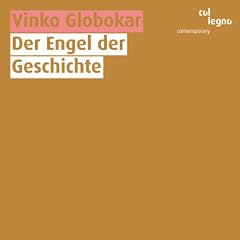
|
Me he encontrado este texto que comenta el disco. Que me ha parecido illustrativo e interesante.
Sigo escuchando. Ya con estos datos llamándome la atención sobre ciertos aspectos.
Vinko GLOBOKAR (b. 1934)
CD 1 [59:32]
Der Engel der Geschichte (2000-2004)
Teil 1, Zerfall [29:45]
Teil 2, Mars [29:45]
CD 2 [62:13]
Teil 3, Hoffnung [31:58]
Les Otages (2003) [30:15]
SWR Sinfonieorchester Baden-Baden und Freiburg/Fabrice Bollon; Martyn Brabbins
ExperimentalStudio des SWR, Freiburg (Engel)
Symphonieorchester des Bayerischen Rundfunks/Arturo Tamayo (Otages)
rec. Hall of Tennis Club T.C.S., Strasbourg, 16-17 September 2004 (Engel); Herkulessaal der Residenz München, 1 December 2006 (Otages)
COL LEGNO WWE 2SACD 20609 [59:32 + 62:13]
Vinko Globokar is one of those composers whose breadth of background almost guarantees a certain amount of unpredictability. Starting out as a jazz musician, he is also a top trombone player, having premiered works for that instrument by the likes of Berio, Kagel, Stockhausen and Takemitsu. He was part of the free improvisation movement in the late 1960s, but as a conductor and thinker on music and creativity in general his practical sense as a musician always gives his work a firm foundation in functional reality – even if creating pieces which connect ensembles remotely via radio link, or as in this case, multiple orchestras in a way which to some extent recalls Stockhausen’s Gruppen.
Der Engel der Geschichte, or ‘The Angel of History’, is a trilogy for two orchestras and a diversity of electronics. The pre-recorded voices which are en element in the opening of the work stand as a symbol for the composer’s intention to "create a sound fresco of the time I am living in." These are early recordings of folk music from former Yugoslavia’s various regions, names which in our time have become notorious labels on mankind’s baggage of guilt, his inhumanity to his neighbour – Bosnia, Serbia, Kosovo … Globokar worked as a jazz trombonist in the region for many years in the late 1940s and early 1950s, so his associations with these countries and his affection for the people must be strong, although this isn’t mentioned in the booklet for this release. The strange thing which happens is that these voices and their ‘strange’ music, placed in this new context, can sound every bit as modern and challenging to my ears as Globokar’s own composition. Later, recordings of dance bands are also inserted; appearing as a briefly opened window into more peaceful, joyous times – a challenging contrast with the dark world from which they emerge.
Globokar was already working on this first movement, ‘Zerfall’, when his attention was brought to a painting by Paul Klee called Angelus Novus, and the German philosopher Walter Benjamin’s writings in relation to it. The quotations included in the booklet are concise, but go a long way towards explaining Globokar’s motivations and what he is expressing: "This is how the angel of history must look. His face is turned towards the past. Where a chain of events appear before us, he sees a single catastrophe, which keeps piling wreckage upon wreckage and hurls it at his feet." At the end of this movement, the singing voices are drowned out by the rolling machinery of massed tanks – a very disturbing aural image.
Der Engel der Geschichte deals with this difficult subject head on, taking as the second movement ‘Mars’ the subject, possibly, of a "police state ending in anarchy". In this movement the sound of one of the orchestras is manipulated in a ‘live electronic alienation’. This is a strange effect, in which at times the orchestra seems to grow extra sonic limbs or to leech into different areas of the soundscape like flourishing bacteria. Echoes and repetitions extend into the dry interruptions of other instruments, and the music develops like a diseased musette under a surface of violent struggle. The shock of distorted perspectives and sounds placed surreally out of context, often with their timbre and emphasis completely malformed, is quite a remarkable effect in SACD mode. Multi-channel recording and reproduction is very good for this kind of music. Close your eyes, and the idea that you are sitting in the hall surrounded by bizarre strangeness is entirely convincing.
The doom-laden themes and generally heavily symbolic nature of the music in this piece are not allowed to destroy our faith in humanity entirely, and the final movement ‘Hoffnung’ introduces "the terrible storm of progress, of hope." Globokar sees this as the present, with positive aspects superimposed upon the negative. Connoisseurs of his musical language will be ready for the glimpses of humour which peep around the corner here – a dancing accordion, some jazzy winds, slides in the brass – not always messengers of fragrance and nice things, but the mood is briefly, very briefly lightened on occasion. Tension rises toward the end, with the development of some cluster chords which heighten a sense of cinematic drama which is undercurrent of the entire movement. This is all very strong stuff, which leaves the listener in no doubt as to the weight of the composer’s message.
Les Otages, ‘The Hostages’, is a ‘musical fiction’ inspired by a newspaper article about hostages. Globokar says no more to illustrate the work, but requested a poem by his friend the writer Edoardo Sanguineti. This is reproduced and translated in the booklet and, casting a grim message of decay and terrors, doesn’t really promise an easy ride. The music opens with a distinct menu of animal sounds, concluding with the laughter of a young child, and religious chanting. Sardonic juxtapositions? Echoes of the natural world and a lost freedom? Our own imaginations and sense of moral perspective are awakened from the start in this remarkable piece, and thus poked into some kind of literal response the mind enquires and seeks clues. As with a real hostage situation, the emotions and senses are dislocated and disorientated. Instruments are made to generate atmospheric environments – night? or searing heat? Natural sounds are a feature. Knocking wood – is it footsteps? or amplified raindrops? As with Der Engel der Geschichte the music is almost pure drama, but here the references are more overt, if almost always open to more than one interpretation. A tapping typewriter is the clearest of clues – but is it? It’s not a real typewriter ... The banalities of human existence – telephones and snoring, are set against the in-your-face angst of the unknown. Fans of horror films should play this to themselves: just them, the music and their imagination in a darkened room. I can guarantee a more memorable experience than just about anything the slimy monster department can come up with.
I have to be honest, this is by no means an easy brace of works. Fans of Globokar will know a little of what to expect, and many of his stylistic fingerprints pop up from time to time. There are the ‘telegraph wire’ sustained strings, shouts – sometimes through megaphones, siren wailing from certain instruments, a general sense of high impact avant-garde expressionism and no sense of compromise. Extremes of range are a feature of the orchestration, from low tuba to piccolo and whistles. There are stretches of almost silence and interruptions of violent power. Globokar’s musical language is almost entirely dramatic in these pieces. There is no room for lyricism or tonality in the conventional sense, but the imagination is taken to places more normally reserved for gritty and well-written fiction in book form. Der Engel der Geschichte is a work on a fearsomely grand and ambitious scale, but doesn’t exist in isolation in Globokar’s oeuvre. It is possible to see it as an extension of the kinds of ideas explored in Les Emigrés from 1982, which anticipates the troubles in former Yugoslavia with its examination of fears and motives in movement within the European population.
Contemporary music needs its commentators on seriously challenging and socially relevant themes, so in this aspect alone this is a release I would urge anyone to explore. It almost goes without saying that the performances are excellent – high in energy, and fully in tune with the composer’s idiom. Recorded sound is also very good, and at times startling in terms of its imaging. You could buy it for mother-in-law, but you’d better make sure in advance that it’s on her wish-list.
Dominy Clements
|

 Identificarse
 Registrarse
 Normas
 FAQ
FAQ Usuarios




 Es lo bueno de oír musica contemporánea que puedes conocer a los autores.
 , Orkney Wedding, With Sunrise compuesto en 1985 por Peter Maxwell Davies, en apenas 15 minutos trata de sumergirnos en el ambiente de las islas Orcadas, un lugar verdaderamente mágico.